
What changes over time
From around your 30s, adults slowly lose muscle, and the pace picks up after 60. Researchers estimate a loss of roughly 3–8% of muscle mass per decade after 30. Less muscle means less strength, a slower metabolism and a higher risk of falls later in life.
For women, the drop in estrogen around menopause adds to this. Many women notice they lose strength and gain weight around the middle even though they eat the same as before.
Your muscles also respond less to the protein you eat as you get older. Scientists call this anabolic resistance: the same meal builds less muscle at 60 than it did at 25. The answer is not to eat huge amounts, but to eat enough at each meal, and to give your muscles a reason to use it.
How much protein do you need?
The standard guideline for adults is 0.8g of protein per kilogram of body weight a day. An international expert group (PROT-AGE) recommends more for older adults: 1.0–1.2g per kilogram, and more for people who are very active or recovering from illness.
For a woman who weighs 70kg (154lb), that means about 70–85g of protein a day.
How you spread it matters too. Studies suggest that 25–30g of protein in one meal is the amount that best switches on muscle building in older adults. Many of us eat most of our protein at dinner and very little at breakfast, so breakfast is usually the easiest place to add more.
What 25–30g looks like
| Food | Portion | Protein |
|---|---|---|
| Chicken breast, cooked | 120g / 4oz | ~36g |
| Salmon fillet, cooked | 140g / 5oz | ~30g |
| Tuna, canned, drained | 1 small can (120g) | ~28g |
| Greek yogurt, plain | 200g / ¾ cup | ~20g |
| Firm tofu | 150g / 5oz | ~20g |
| Lentils, cooked | 1 cup (200g) | ~18g |
| Cottage cheese | ½ cup (115g) | ~13g |
| Eggs | 2 large | ~12g |
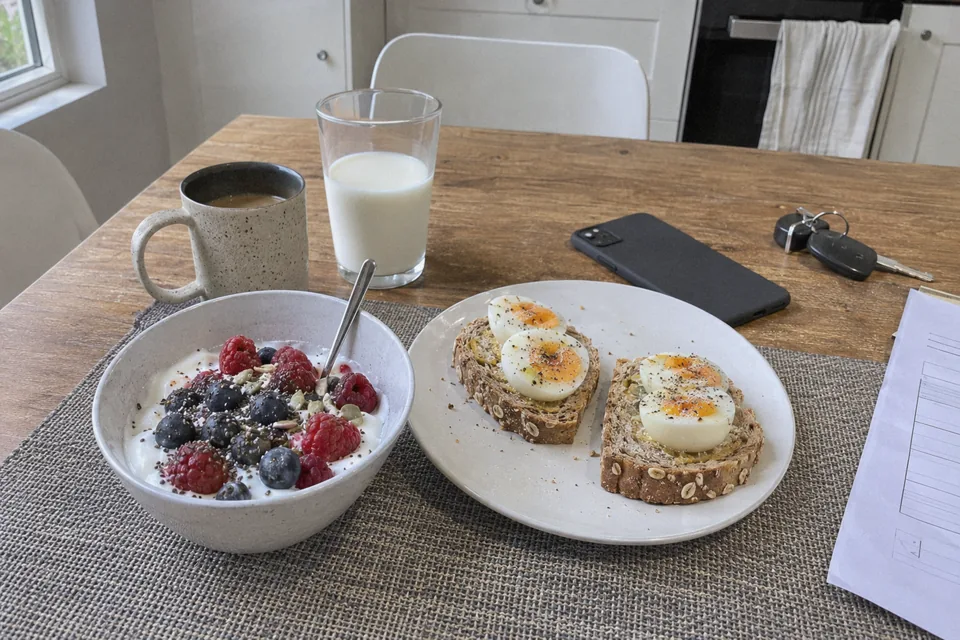
A bowl of Greek yogurt with seeds, two eggs on toast with a glass of milk, or a chicken and lentil salad all land in the 25–30g range.
Pair it with strength training
Protein gives your muscles the building blocks; strength training gives them the signal to use them. Two or three short sessions a week, with weights, resistance bands or your own body weight, make the biggest difference. You can start at any age.
A simple daily plan
- Breakfast: Greek yogurt bowl with berries and toasted seeds (32g).
- Lunch: chicken, lentil and roasted pepper salad (35g).
- Snack: cottage cheese with pear and walnuts (20g).
- Dinner: sheet-pan salmon with greens and white beans (42g).
Who should check with a doctor first
If you have kidney disease, take medication that affects your kidneys, or have been told to limit protein, talk to your doctor or a registered dietitian before eating more.
Sources
Bauer J, et al. Evidence-based recommendations for optimal dietary protein intake in older people: a position paper from the PROT-AGE Study Group. J Am Med Dir Assoc. 2013.
Paddon-Jones D, Rasmussen BB. Dietary protein recommendations and the prevention of sarcopenia. Curr Opin Clin Nutr Metab Care. 2009.
Volpi E, Nazemi R, Fujita S. Muscle tissue changes with aging. Curr Opin Clin Nutr Metab Care. 2004.