
The doctor looks at a number on the screen and says, “Let’s keep an eye on that.” Or someone you love gets a phone call that changes everything, and that night you lie awake doing the math on your own life.
How many good years do I have? Will I be the one looking after them, or the one being looked after?
Then the noise starts. Cut this. Fear that. Buy the $60 powder. So let’s start somewhere quieter, with a fruit that costs less than a coffee.
We’ll be honest from the first line: no single food adds years to your life. But long-term health is built from small things you repeat, and few are as easy to repeat as a banana.
What’s inside one banana
A medium banana gives you about 420mg of potassium, 3g of fiber and a quarter of your daily vitamin B6, all for around 105 calories.
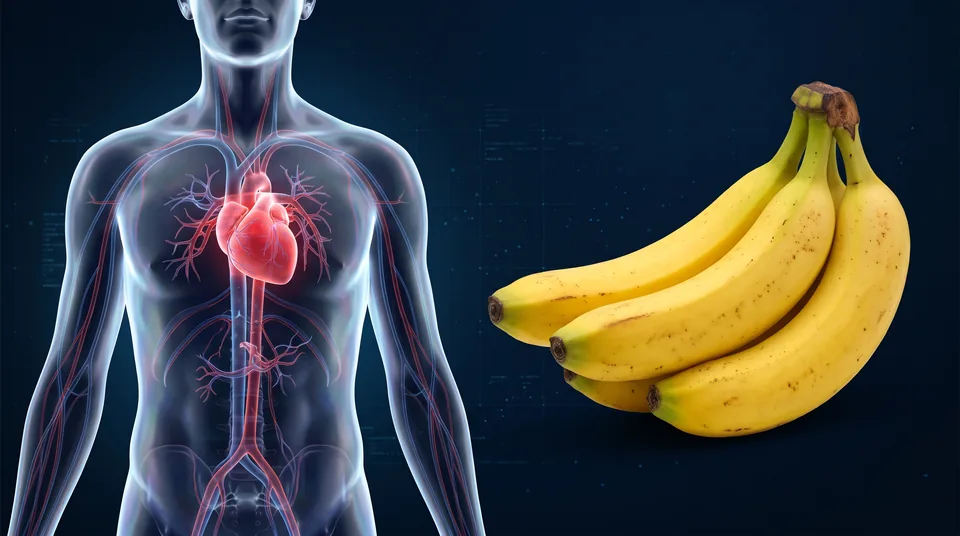
Your heart and blood pressure
High blood pressure is the one you can’t feel. You can be busy and cheerful while the number climbs.
Potassium helps keep it in check. A review led by World Health Organization researchers found that eating more potassium lowered blood pressure in people with high blood pressure, and people who ate more of it had a 24% lower risk of stroke. That’s potassium from the whole diet, but one banana covers roughly 12–16% of what an adult needs in a day.
How long you stay well
Harvard researchers followed more than 100,000 people for up to 30 years. Those who ate about five servings of fruit and vegetables a day, two of them fruit, had a 13% lower risk of death over the study period than people who ate two servings. Fruit juice didn’t show the same benefit.
It’s a link, not proof. Still, it’s hard to read that number and not think of the people you want more time with. Only about 1 in 8 American adults eats enough fruit, and one banana at breakfast puts you halfway there.
Stress, and the days you forget yourself
When stress runs high, food is the first thing to go. You skip lunch, finish the kids’ leftovers standing up, and call coffee a meal.
An Australian study of 8,689 adults found that people who ate the most fruit and vegetables reported 10% lower stress than people who ate the least. It was a snapshot, so it can’t prove cause.
A banana won’t fix your bills or the worry that wakes you at 3 a.m. But peeling one on a hard day is a small way of saying, I matter too.
Your gut, and the fiber most of us miss
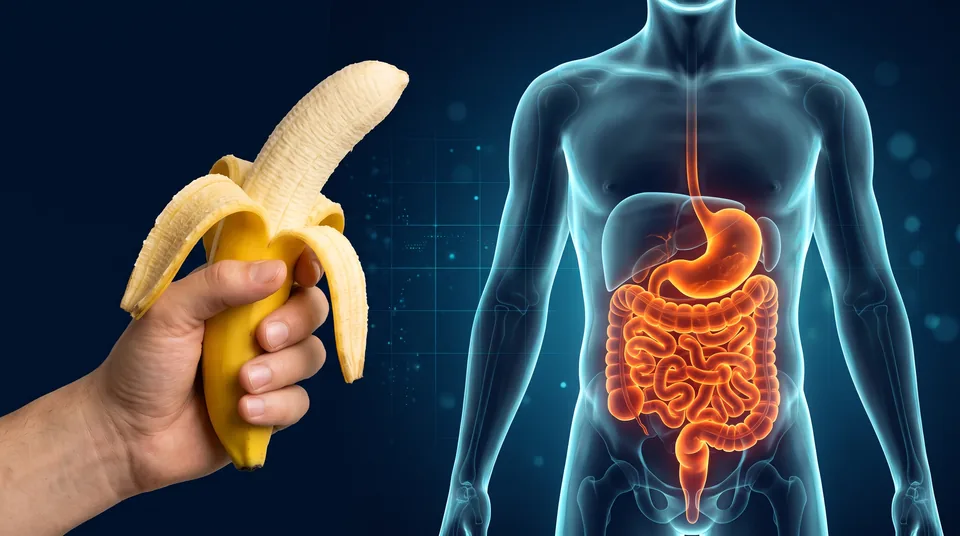
A review in The Lancet of 185 long-term studies and 58 trials found that people who ate the most fiber had a 15–30% lower risk of death from any cause, and of heart disease, stroke, type 2 diabetes and colon cancer, than people who ate the least. A banana gets you about 3g of the 25–29g a day linked with the biggest drop.
But aren’t bananas full of sugar?
A medium banana has about 14g of natural sugar, packaged with fiber and potassium, which is very different from a soda. Eat it with yogurt or nuts for a steadier snack.
How many bananas a day is right?
For most healthy people, one or two a day fits well alongside other fruit and vegetables. Check with your doctor first if you have kidney disease, or take medication that can raise potassium, such as ACE inhibitors or spironolactone. If you have diabetes, follow your care team’s advice on portions.
Why almost nobody keeps this up
A plain banana is boring by Wednesday. You buy six, eat two, and watch the rest go soft in the bowl. The habits that last are the ones you look forward to:
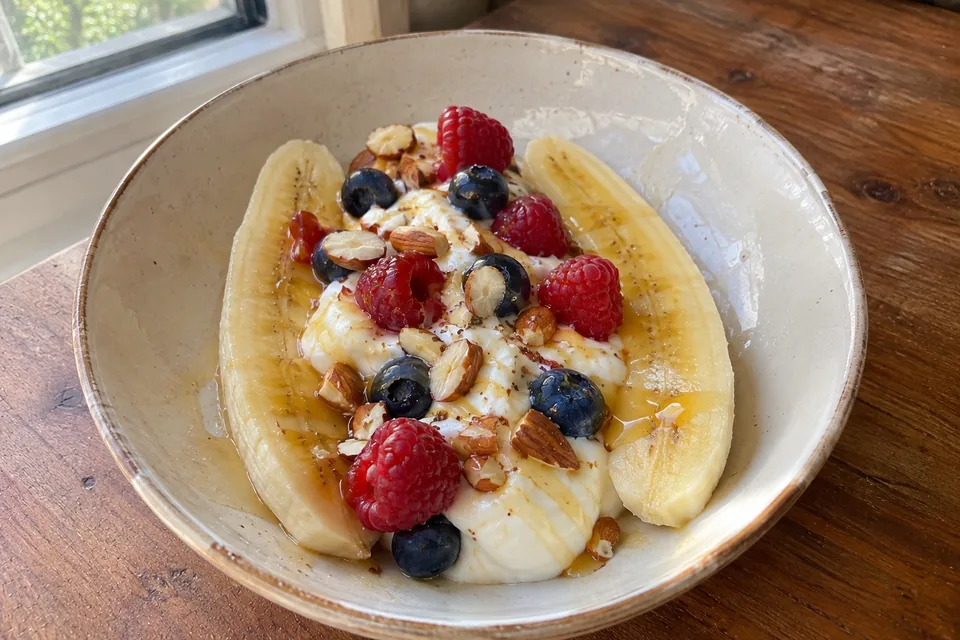
- Breakfast: halve a banana, then add Greek yogurt, berries and almonds.
- The 3 p.m. slump: roll one in a whole-wheat wrap with peanut butter.
- After dinner: blend frozen banana with a spoonful of yogurt into soft-serve.
If you want it to last
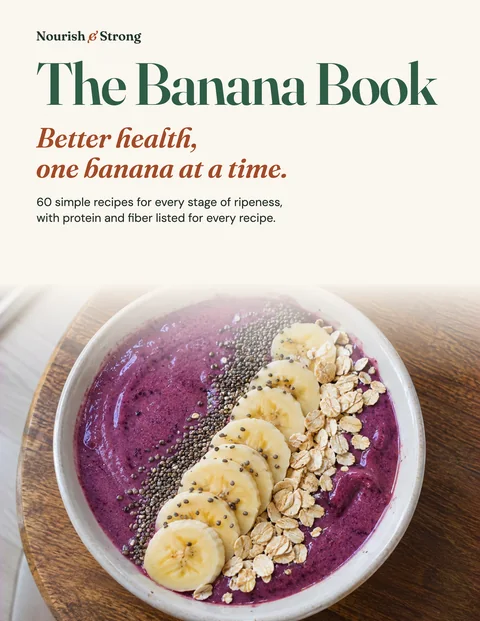
The Banana Book
60 simple banana recipes, from five-minute breakfasts to warm banana bread, with protein and fiber listed for every one. The whole book costs about the same as a coffee.
Launch price. Instant PDF download. 14-day money-back guarantee.
You can’t control every number on that screen. You can decide what you eat at breakfast tomorrow.
Sources
US Department of Agriculture. FoodData Central: bananas, raw.
Aburto NJ, et al. Effect of increased potassium intake on cardiovascular risk factors and disease. BMJ. 2013. doi:10.1136/bmj.f1378
Wang DD, et al. Fruit and vegetable intake and mortality. Circulation. 2021. doi:10.1161/CIRCULATIONAHA.120.048996
Lee SH, et al. Adults meeting fruit and vegetable intake recommendations, United States, 2019. CDC MMWR. 2022. Read the report
Radavelli-Bagatini S, et al. Fruit and vegetable intake is inversely associated with perceived stress across the adult lifespan. Clinical Nutrition. 2021. doi:10.1016/j.clnu.2021.03.043
Reynolds A, et al. Carbohydrate quality and human health. The Lancet. 2019. doi:10.1016/S0140-6736(18)31809-9
National Academies of Sciences, Engineering, and Medicine. Dietary Reference Intakes for Sodium and Potassium. 2019.
This article is general information, not medical advice. Please talk to your doctor about your own health.