

The short answer: gentle, regular movement is usually the best place to start. Arthritis UK suggests five exercises: knees to chest, knee rolls, arching and hollowing, half push-ups and a deep lunge. Do each one a few times and build up slowly. The NHS says to stop if your pain gets worse, and to see a doctor.
It can happen over nothing. You bend to pick up a sock, and your back grabs. Now you’re moving like you’re made of glass, and part of you wants to lie down until it passes.
That’s a very human reaction. It’s also the one the experts want you to resist.
Before you start: what’s normal and what isn’t
Arthritis UK calls staying active the most important thing you can do to recover from back pain. Too much rest can make the pain worse. It says back pain should start to ease after 2 weeks and usually passes after 4 to 6 weeks.
The NHS agrees that it usually improves within a few weeks. Sometimes it lasts longer or comes back.
Exercise may feel a little sore at first. Guy’s and St Thomas’ NHS trust explains that pain can rise when you restart exercise or do too much at once. Its message is that “hurt does not equal harm”. If it’s more than you can tolerate, go back to what you managed recently and build up in smaller steps.
Painkillers can have a place too. The trust says they can help you get back to your usual activities. The NHS suggests anti-inflammatories such as ibuprofen if they’re suitable for you, and says paracetamol alone isn’t recommended for back pain. Check with a pharmacist if you’re not sure.
Severe pain is different. Arthritis UK says to book in with your doctor or physiotherapist if you have severe pain during these exercises, or if the pain hasn’t improved in a few weeks.
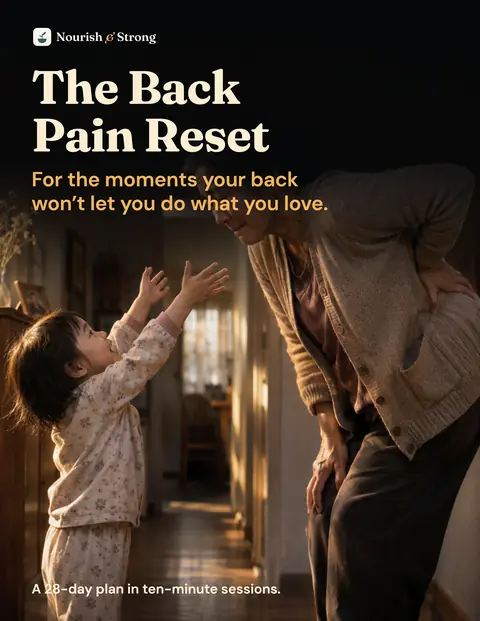
Want to know what to do tomorrow, too?
The Back Pain Reset
A simple 28-day plan with ten-minute sessions, 12 exercises with pictures and a rescue card. Only $3.
Start here: three gentle exercises
These steps and amounts come from the Arthritis UK back pain exercise sheet. You can do the first two on the floor or on your bed. We’ve split the five into two groups to make them easier to follow. That’s our grouping, not a medical rule.
1. Knees to chest
- Lie on your back with your knees bent and your feet flat.
- Bring one knee up and use your hands to pull it gently towards your chest.
- Hold for 5 seconds, then relax.
- Repeat with the other knee. Do this 5 times on each side.
2. Knee rolls
- Lie on your back with your knees bent and your feet together.
- Roll your knees to one side. Keep your shoulders flat.
- Hold for 10 seconds, then roll back to the middle.
- Repeat on the other side. Do this 3 times on each side.
3. Arching and hollowing
- Get on your hands and knees, with your hands under your shoulders and your knees under your hips.
- Arch your back upwards and let your head drop. Hold for 5 seconds.
- Return to the start.
- Slowly lift your head, relax your tummy and stick your bottom out. Hold for 5 seconds.
- Repeat 5 times.
Then add these two
Arthritis UK says you can adjust any position so it’s comfortable. Start with a few of each, and do more as you get used to them.
4. Half push-ups
- Lie on your front with your forearms flat and your elbows bent at your sides. Look down and keep your neck straight.
- Slowly push down on your hands and arch your back up. Keep your hips down.
- Hold for 5 to 10 seconds, then lower yourself back down.
- Build up to 10 repeats over time.
If you can’t fully straighten your arms, arch halfway and rest on your elbows.
5. Deep lunge
- Kneel on your right knee, with your left foot on the floor in front of you.
- Face forwards and lift your back knee up. Arthritis UK says to keep your upper body upright, without leaning forward.
- Hold for 5 seconds. Repeat 3 times, then swap legs.
Which exercise is best?
Nobody has found one winner. A large Cochrane review from 2021 found that exercise is probably effective for easing long-term low back pain, compared with no treatment or usual care. The certainty was moderate. The gain in day-to-day function was small, so it’s worth doing, but it won’t do everything. The part of the review we read didn’t name one type as clearly better than the rest.
So the best exercise may be the one you’ll keep doing. Arthritis UK suggests picking something you enjoy, and says swimming, walking, yoga and Pilates all help. The American Academy of Orthopaedic Surgeons advises mixing aerobic activity, such as walking or swimming, with exercises that strengthen and stretch your back and tummy muscles.
Don’t stop when it feels better, either. Arthritis UK says carrying on can reduce the chance of the pain coming back.
If you can pin your pain on something, go after that too. Read what helps lower back pain from sitting, or how to sleep with lower back pain. If the pain runs down your leg, try these sciatica exercises instead.
When to get help
Back pain usually improves within a few weeks. But the NHS lists some signs that need quick attention.
Call emergency services or go to the emergency department if you have back pain and:
- Pain, tingling, weakness or numbness in both legs
- Loss of feeling around your genitals or bottom
- Changes in your bladder or bowels, such as trouble peeing or losing control of pee or poo
- Your penis or vagina feels different during sex, you can’t get or keep an erection, or you can’t orgasm
- Chest pain
- Pain that started after a serious accident, such as a car crash
Don’t drive yourself. Ask someone to take you, or call an ambulance.
Get urgent medical advice if you feel hot, cold, shivery or generally unwell, or if you have sudden severe pain, or pain that’s getting worse quickly.
See your doctor if:
- It hasn’t improved after a few weeks of home treatment
- It stops you doing everyday things, or you’re struggling to cope
- You’ve lost weight without trying
- You have a lump, swelling or a change in the shape of your back
- It doesn’t improve with rest, or it’s worse at night
- It gets worse when you sneeze, cough or poo
Your next step
Today, try exercise 1 and exercise 2, a few times each, on your bed if the floor feels too far away. Tomorrow, do them again. Then add one more.
Ready for more than a list?
The Back Pain Reset
A simple 28-day plan in ten-minute sessions, with 12 illustrated exercises, three levels and a rescue card for bad days. Only $3.
Quick questions
What is the best exercise for lower back pain?
No single exercise has been shown to be best. A 2021 Cochrane review found exercise is probably effective for long-term low back pain, and Arthritis UK suggests choosing something you enjoy so you stick with it.
Should I exercise if my back hurts?
Usually, yes. Arthritis UK says staying active is the most important thing you can do, and that too much rest can make pain worse. The NHS says to stop if your pain gets worse and see a doctor.
How long does it take for back pain exercises to work?
Arthritis UK says back pain should start to ease after 2 weeks and usually passes after 4 to 6 weeks. See your doctor if it hasn’t improved in a few weeks.
Can I do back exercises in bed?
Yes. The Arthritis UK exercise sheet says several of these exercises can be done on the floor or on your bed, including knees to chest and knee rolls.
Is walking good for lower back pain?
It may help. The NHS says walking, swimming, yoga and Pilates may help back pain, and Arthritis UK lists the same activities.
This article is general information, not medical advice. If you’re worried about your back, please talk to your doctor.
Sources
- NHS. Back pain. Reviewed March 2026.
- Arthritis UK. Back pain: information and exercise sheet.
- Arthritis UK. Exercises for the back.
- Guy’s and St Thomas’ NHS Foundation Trust. Physiotherapy and exercises for low back pain.
- Hayden JA, et al. Exercise therapy for chronic low back pain. Cochrane Database of Systematic Reviews, 2021.
- American Academy of Orthopaedic Surgeons. Low Back Pain.