

The short answer: sleep on your side with a pillow between your knees, or on your back with a pillow under your knees. Both are advised by Mayo Clinic and Cleveland Clinic. Try to avoid sleeping on your stomach. No position suits everyone, so stop anything that hurts and go with what lets you sleep.
You know how this goes. It’s 3am. You’ve tried your left side, your right side and something in between. Each time you turn, your back reminds you it’s there. You lie still and start working out how little sleep you can get by on.
A few small changes to how you lie can take some of the strain away.
The best sleeping positions for lower back pain
On your side
Mayo Clinic says a pillow between your legs helps line up your spine, pelvis and hips. A full-length body pillow works too.
- Keep your knees slightly bent.
- Use a head pillow thick enough that your head and neck don’t droop.
- Switch sides regularly. Cleveland Clinic says this helps prevent imbalances.
- Rolling onto your front in the night? Cleveland Clinic suggests putting a pillow in front of you, or behind your back if you tend to roll that way.
On your back
Cleveland Clinic says this position puts the least pressure on your spine.
- Put a pillow under your knees. Mayo Clinic says this relaxes your back muscles and keeps the natural curve in your lower back.
- Need more support? Mayo Clinic suggests a small rolled towel under your waist.
- Choose a head pillow that keeps your neck in line with your chest and back.
On your stomach
This is the one to avoid if you can, because it can strain your neck and lower back. If it’s the only way you can sleep, Mayo Clinic suggests a pillow under your hips and lower stomach. Cleveland Clinic suggests a very thin head pillow, or none.
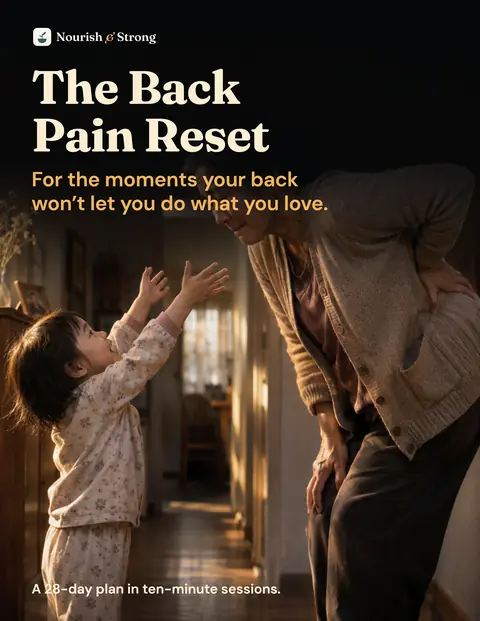
Better nights start with your days
The Back Pain Reset
A simple 28-day plan with ten-minute sessions, 12 exercises with pictures and a rescue card. Only $3.
Where the advice differs
Even the big names don’t agree on everything, and that’s worth knowing.
- How far to bend your knees. Mayo Clinic says to bend them slightly towards your chest. Cleveland Clinic warns against curling up in the fetal position, and says to keep your thighs roughly in line with your body.
- Side or back? Both are recommended. We didn’t find a source that ranks one clearly above the other for everyone.
- It depends on the cause. Cleveland Clinic says the best position for sciatica depends on what’s behind it. With spinal stenosis, leaning slightly forward can feel better, so a large wedge pillow, a recliner or even the fetal position may help. With sciatica, lying on the side opposite your pain can take pressure off the nerve.
Try one change for a few nights. Cleveland Clinic’s advice is to experiment with positions and pillows, and stop anything that causes pain.
Do you need a new mattress?
Perhaps, but try the cheap fixes first. Cleveland Clinic suggests testing pillows or a mattress topper on your current bed before you buy anything.
On firmness, the evidence leans towards medium-firm. Cleveland Clinic points to a review of studies that found a medium-firm mattress is best for lower back pain. That’s about 6 out of 10 on a firmness scale. It should feel supportive, not something you sink into.
Advice isn’t fully settled, though. Another Cleveland Clinic guide recommends a firm mattress. Whichever you choose, it should keep your spine in a neutral line.
Cleveland Clinic says a mattress may be due for replacing if:
- It’s noisy, sagging or damaged
- You feel less stiff after sleeping in hotel beds than in your own
- It’s about six to eight years old, which is the Sleep Foundation guideline it quotes
Before bed and on waking
Warm up first. Cleveland Clinic suggests a warm bath, a heating pad or a hot water bottle before bed. The NHS says heat can help with stiffness or muscle spasms. Wrap a hot water bottle in a tea towel, and choose a heating pad with an auto shut-off.
Move a little during the day. The NHS advises staying active and avoiding long periods in bed. Our guide to exercises for lower back pain has five gentle ones, and two of them can be done on your bed.
Stretch before you stand. Cleveland Clinic suggests lying on your back, bringing one knee to your chest, holding for three seconds, then switching legs.
Get up in stages. Cleveland Clinic’s method works like this:
- Roll onto your side and bring both knees up.
- Swing your legs off the bed.
- Push up with your hands, without bending at the waist.
- Sit on the edge of the bed for a moment, then stand using your legs.
If you wake up stiff every day, read why you might be so stiff in the morning. And if your legs are the ones waking you, see our guide to leg cramps at night.
Why this is worth the effort
Cleveland Clinic says pain and poor sleep can feed each other, so working on one may help the other. The US National Institute of Arthritis and Musculoskeletal and Skin Diseases also says chronic poor sleep can make back pain more frequent and more severe. Better nights won’t solve everything, but they’re a fair place to start.
When to get help
Pay attention to night pain. The NHS says to see a doctor if your back pain doesn’t improve with rest, or if it’s worse at night.
Call emergency services or go to the emergency department if you have back pain and:
- Pain, tingling, weakness or numbness in both legs
- Loss of feeling around your genitals or bottom
- Changes in your bladder or bowels, such as trouble peeing or losing control of pee or poo
- Your penis or vagina feels different during sex, you can’t get or keep an erection, or you can’t orgasm
- Chest pain
- Pain that started after a serious accident, such as a car crash
Don’t drive yourself. Ask someone to take you, or call an ambulance.
Get urgent medical advice if you feel hot, cold, shivery or generally unwell, or if you have sudden severe pain, or pain that’s getting worse quickly.
See your doctor if:
- It hasn’t improved after a few weeks of home treatment
- It stops you doing everyday things, or you’re worried about it
- You’ve lost weight without trying
Cleveland Clinic also says to see someone if you have morning back pain most mornings for two or three months, or if it’s getting worse.
Your next step
Tonight, put one spare pillow between your knees or under them. That’s the whole experiment. It costs nothing, and you’ll know more by the morning.
For your back, day and night
The Back Pain Reset
A simple 28-day plan in ten-minute sessions, with 12 illustrated exercises, three levels and a rescue card for bad days. Only $3.
Quick questions
What is the best sleeping position for lower back pain?
On your side with a pillow between your knees, or on your back with a pillow under your knees. Cleveland Clinic says back sleeping puts the least pressure on your spine, but no position suits everyone.
Is it bad to sleep on your stomach with back pain?
It can strain your neck and lower back, so try another position if you can. If you can’t, Mayo Clinic suggests a pillow under your hips and lower stomach.
Is a firm or soft mattress better for back pain?
Cleveland Clinic points to a review that found a medium-firm mattress is best for lower back pain, though another of its guides recommends a firm one. Try pillows or a topper first.
Why is my back pain worse at night?
There are many possible reasons, and lying still for hours can add stiffness. The NHS says to see a doctor if back pain doesn’t improve with rest or is worse at night.
How should I get out of bed with back pain?
Cleveland Clinic suggests rolling onto your side, bringing both knees up, swinging your legs off the bed and pushing up with your hands. Then sit for a moment before you stand.
This article is general information, not medical advice. If you’re worried about your back, please talk to your doctor.
Sources
- Mayo Clinic Staff, via Memorial Health System. Sleeping positions that reduce back pain. The mayoclinic.org page would not load for us, so we read this copy, which credits Mayo Clinic Staff.
- Cleveland Clinic. Best Sleeping Positions for Pain.
- Cleveland Clinic. Why Your Lower Back Pain Is Worse in the Morning.
- Cleveland Clinic. How To Get Better Sleep With Sciatica Pain.
- Cleveland Clinic. Low Back Pain Coping Tips.
- NHS. Back pain. Reviewed March 2026.
- National Institute of Arthritis and Musculoskeletal and Skin Diseases. Back Pain.