

The short answer: the NHS says back pain often improves on its own within a few weeks. Stay active, try gentle exercises, use a wrapped ice or heat pack, and take ibuprofen if it suits you. Avoid long periods in bed. Get emergency help for numbness around your genitals, problems in both legs, or bladder or bowel changes.
When your back goes, you want one thing: for it to stop. There’s no switch for that. But the honest list of what helps is short, cheap and mostly in your own hands.
What should you do today?
- Keep moving. The NHS says to stay active and carry on with your daily activities as best you can.
- Stay out of bed. It’s tempting, but the NHS says not to stay there for long periods.
- Try gentle exercises. Start with these five exercises for lower back pain. Stop if your pain gets worse.
- Use ice or heat. Wrap either in a tea towel. The NHS says ice can reduce pain and swelling, and heat can relieve stiffness or muscle spasms.
- Choose pain relief carefully. The NHS suggests anti-inflammatories like ibuprofen, which may not suit everyone. Check with a pharmacist if you’re unsure.
Can you fix a lower back?
Often it settles without being “fixed” at all. The NHS says it’s not always obvious what causes back pain, and a common cause is a pulled muscle. Only very rarely is it a sign of something serious.
So your job is mostly to keep your back moving while it recovers. If you can spot a trigger, tackle that too. These guides cover back pain from sitting and sleeping with back pain. If pain runs down one leg, read about sciatica exercises.
What works for back pain, and what doesn’t?
NICE, which sets UK clinical guidance, gives a clear steer on this.
| Option | What the guidance says |
|---|---|
| Exercise | Recommended. A 2021 Cochrane review found it’s probably effective for long-term low back pain |
| Walking, swimming, yoga, pilates | The NHS says these may help ease back pain |
| Anti-inflammatories | The NHS suggests them. NICE says to use the lowest effective dose for the shortest time |
| Paracetamol on its own | Not recommended by NHS or NICE, though it may be used with another painkiller |
| Belts or corsets | NICE says not to offer them |
| Foot orthotics | NICE says not to offer them |
| Routine scans | NICE says not to routinely offer imaging in a non-specialist setting |
The best exercise isn’t a single move. Arthritis UK suggests choosing something you enjoy, so you’ll stick with it.
How long does back pain take to go away?
The NHS says back pain often improves within a few weeks. Arthritis UK says it should start to ease after 2 weeks and usually passes after 4 to 6 weeks. Go by that, not by one bad morning.
What if your back pain isn’t getting better?
The NHS says other treatments may be recommended if your pain doesn’t improve after a few weeks. These include group exercise sessions and physiotherapy, manual therapy, cognitive behavioral therapy to help you cope with the pain, and a procedure to seal off certain nerves for long-term lower back pain.
When should you get help for back pain?
Call emergency services or go to the emergency department if you have back pain and:
- Pain, tingling, weakness or numbness in both legs
- Loss of feeling around your genitals or bottom
- Changes in your bladder or bowels, such as difficulty peeing or losing control
- Changes in how your genitals feel during sex, or erection problems
- Chest pain
- Pain that started after a serious accident
Don’t drive yourself. Ask someone to take you, or call an ambulance, and bring your medicines.
Get an urgent appointment if you feel hot, cold, shivery or generally unwell, or the pain is severe, starts suddenly or is getting worse quickly.
See your doctor if:
- It hasn’t improved after a few weeks at home
- It’s stopping your day-to-day activities, or you’re struggling to cope
- You’ve lost weight without trying
- There’s a lump or swelling in your back, or its shape has changed
- It doesn’t improve after resting, or it’s worse at night
- It’s worse when sneezing, coughing or pooing
- It’s between your shoulders, rather than in your lower back
Your next step
Get up now and walk for a couple of minutes. Then pick one exercise and do it today. Small and regular beats big and rare.
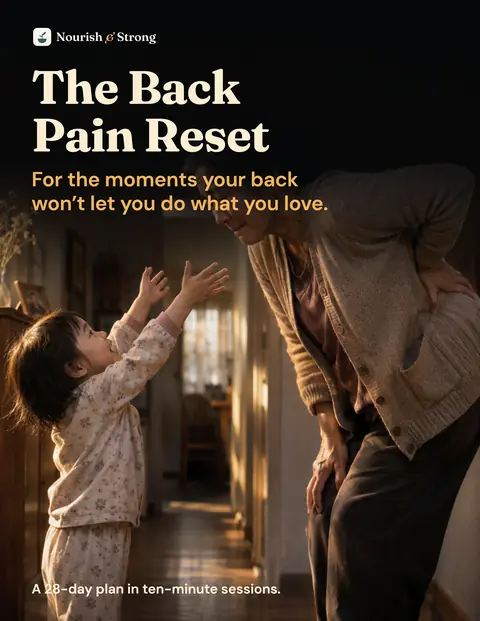
Want it laid out day by day?
The Back Pain Reset
A simple 28-day plan in ten-minute sessions, with 12 illustrated exercises, three levels and a rescue card for bad days. Only $3.
Quick questions
How can I get rid of back pain fast?
There’s no instant fix. The NHS says to stay active, try exercises and stretches, use an anti-inflammatory if it’s suitable for you, and use a wrapped ice pack or heat pack. Back pain often improves within a few weeks.
Should I rest with back pain?
Not for long. The NHS says to stay active and not to stay in bed for long periods.
Is heat or ice better for back pain?
The NHS suggests both, for different jobs. Ice can reduce pain and swelling, and heat can relieve stiffness or muscle spasms. Wrap either in a tea towel.
Does paracetamol help back pain?
The NHS says paracetamol on its own isn’t recommended for back pain, but it may be used with another painkiller. Check with a pharmacist if you’re unsure.
When should I see a doctor about back pain?
See your doctor if it hasn’t improved after a few weeks, stops your daily activities, or is worse at night. Get emergency help for symptoms in both legs, numbness around your genitals or bottom, or bladder or bowel changes.
This article is general information, not medical advice. If you’re worried about your pain, please talk to your doctor.
Sources
- NHS. Back pain.
- NICE. Low back pain and sciatica in over 16s: assessment and management (NG59).
- Hayden JA, et al. Exercise therapy for chronic low back pain. Cochrane Database of Systematic Reviews, 2021.
- Arthritis UK. Back pain: information and exercise sheet.