

The short answer: yes, menopause can cause insomnia. Sleep problems are reported by 40% to 60% of women in menopause, and waking in the night is the most common complaint. Hot flashes, mood changes and a higher risk of sleep apnea all play a part. The first-choice treatment is a short talking therapy called CBT-I, which worked in a trial of women with menopausal insomnia and hot flashes.
Can menopause cause insomnia?
Menopause can cause insomnia, and the NHS lists it among the conditions that do. A 2018 review in Sleep Medicine Clinics by Fiona Baker and colleagues found strong evidence that sleep problems become more common through the menopause transition, even after allowing for age. One analysis it cites, pooling 24 studies, found these odds of sleep trouble compared with women who hadn’t reached perimenopause:
| Stage | Odds of sleep problems (before perimenopause = 1) |
|---|---|
| Perimenopause | 1.60 |
| After menopause | 1.67 |
| Menopause after surgery | 2.17 |
For some, it goes beyond a few bad nights. In a phone survey of almost 1,000 women, 26% of those in perimenopause met the criteria for an insomnia diagnosis, most often trouble staying asleep. The NHS counts it as insomnia when you regularly struggle to get to sleep, wake several times, wake early and can’t get back to sleep, or feel tired and irritable in the day.
Why does menopause cause insomnia?
Menopause causes insomnia mainly through hot flashes at night, along with mood changes and a rise in sleep apnea. Several things often overlap:
| Cause | What the research reports |
|---|---|
| Hot flashes and night sweats | Affect up to 80% of women in the transition, for a median of 7.4 years in the SWAN study. Women with moderate to severe hot flashes were almost three times as likely to report waking often in the night. |
| Low mood and anxiety | Sleep and mood affect each other in both directions. Depression was linked to trouble falling asleep and waking too early, while hot flashes were linked to waking in the night. |
| Sleep apnea | More common after menopause. In the Wisconsin Sleep Cohort, women after menopause were 2.6 times as likely to have sleep apnea and 3.5 times as likely to have the moderate form, after allowing for age, weight and smoking. |
| Bladder changes | The Office on Women’s Health says bladder symptoms can disrupt sleep, and the NHS notes needing to pee more often, including at night. |
| Restless legs and aging | Restless legs and limb movements become more common with age; the review suggests aging matters more than hormones here. |
In women, sleep apnea symptoms more often include insomnia, fatigue and headaches, says the National Heart, Lung, and Blood Institute. If you wake drenched, our guide to night sweats covers the causes and the cooling steps.
What is CBT-I for menopause insomnia?
CBT-I, or cognitive behavioral therapy for insomnia, is a 6- to 8-week program that retrains how you think about and approach sleep. The National Heart, Lung, and Blood Institute says it’s usually the first treatment recommended for long-term insomnia, and you can do it in person, by phone or online. It has five parts:
| Part | What it does |
|---|---|
| Cognitive therapy | Makes you less anxious about not sleeping |
| Relaxation | Teaches ways to calm down and fall asleep faster |
| Sleep education | Covers the habits that help sleep |
| Sleep restriction | Sets a fixed time in bed, then lengthens it as your sleep improves |
| Stimulus control | Bed only when sleepy, up if you can’t sleep, bed only for sleep and sex |
The evidence is solid. The American College of Physicians recommends CBT-I as the first treatment for chronic insomnia in all adults, a strong recommendation. For menopause specifically, a 2016 trial in JAMA Internal Medicine gave 106 women with insomnia and at least two hot flashes a day either six phone sessions of CBT-I or menopause education over 8 weeks. Insomnia scores fell by 9.9 points with CBT-I and 4.7 points with education, on a 28-point scale. The gains held at 6 months.
The NHS says a GP may offer CBT for insomnia face to face or through an online program, so ask your doctor what’s available near you.
How can you sleep better during menopause?
You can sleep better during menopause by keeping a fixed wake time, a cool dark bedroom and caffeine and alcohol well away from bedtime. These habits come from the NHS, the National Heart, Lung, and Blood Institute (NHLBI) and the National Institute on Aging (NIA):
| Habit | What the source says |
|---|---|
| Same wake time every day | Get up at the same time daily, weekends included, and don’t sleep in after a bad night (NHS, NHLBI) |
| Cool, dark, quiet room | Sleep somewhere cool, quiet and dark; use blinds, an eye mask or earplugs if needed (NHLBI, NHS) |
| Bed only when sleepy | Go to bed when sleepy and get up if you can’t sleep (NHS, NHLBI) |
| Caffeine | None in the 6 hours before bed; that includes tea, coffee, chocolate and soda (NHS, NIA) |
| Alcohol | It may help you drop off, but sleep is lighter and you wake more often (NHLBI) |
| Exercise | Move in the daytime; the cutoff before bed is given as 3 hours (NIA), 4 hours (NHS) or 5 to 6 hours (NHLBI) |
| Naps | Avoid them, especially in the afternoon or evening (NHLBI, NIA) |
| Wind-down | Relax for at least an hour before bed, with a book or a bath, and avoid screens right before bed (NHS) |
| Late meals and drinks | No big meal late at night; limit drinks close to bedtime to cut bathroom trips (NHS, NHLBI) |
For hot flashes, the NHS also suggests lightweight night clothes and a cool bedroom. Yoga, exercise, acupuncture and soy have been tried for menopausal insomnia with mixed results, the Baker review says.
What does a 2-week plan for menopause sleep look like?
A 2-week plan puts the habits above in order and gives you a sleep diary to take to your doctor. The NIA suggests keeping that diary for a couple of weeks. This isn’t CBT-I itself, which sets your time in bed with a trained guide, but it’s a useful start.
| Days | What to do |
|---|---|
| 1 to 2 | Start a diary: bedtime, wake time, night wakings, hot flashes, caffeine, alcohol and exercise. Pick one wake time you can keep every day. |
| 3 to 4 | Set up the bedroom: fan or open window, light layered bedding, cotton night clothes, cold water by the bed, blinds or an eye mask. |
| 5 to 7 | Last caffeine at least 6 hours before bed. Skip naps. Move in the daytime. |
| 8 to 10 | Add a one-hour wind-down with screens off. Go to bed only when sleepy. If you’re awake and frustrated, get up and do something calm until you feel sleepy. |
| 11 to 12 | Notice alcohol and late meals in your diary. Try a few evenings without either and compare. |
| 13 to 14 | Review the diary. If you still wake most nights, book an appointment and bring it with you. |
Hold the same wake time through all 14 days, even after a rough night.
Does HRT help menopause insomnia?
HRT can help menopause insomnia, especially when hot flashes are what’s waking you, according to the Baker review. It found that hormone therapy eases sleep problems women report, mostly when hot flashes are present. Where hormones aren’t suitable, it says some antidepressants modestly reduce insomnia in women with hot flashes, and a single trial found gabapentin improved sleep quality. Each has side effects to weigh, so these are options to discuss with your doctor. The risks of HRT are set out in our perimenopause symptoms guide.
Sleeping pills play a small part. The NHS says doctors now rarely prescribe them, and only for a few days or weeks at most, because they can cause serious side effects and dependence. It says pharmacy sleep aids may help for 1 to 2 weeks and aren’t meant for longer, so check with your doctor before taking anything for sleep.
When should you see a doctor about menopause insomnia?
See a doctor if better sleep habits haven’t helped, if you’ve had trouble sleeping for months, or if it’s making daily life hard to cope with. That’s the NHS advice. The Office on Women’s Health also says to tell your provider about any trouble sleeping in menopause, because treating night sweats can help you sleep better.
Ask about sleep apnea if a partner notices loud snoring, gasping or pauses in your breathing, or if you wake with a dry mouth or headache, feel sleepy all day or get up often to pee. The NHLBI says a sleep study may be needed, and the NIA warns that untreated sleep apnea can lead to serious problems, including heart attack.
Tiredness has plenty of other causes. Our guide to why you might always be tired walks through them before your appointment. For quicker nights, see how to fall asleep fast and the best sleeping position for you.
If you’d like your meals planned out too, the Menopause Meal Plan below gives you four weeks of high-protein meals with grocery lists.
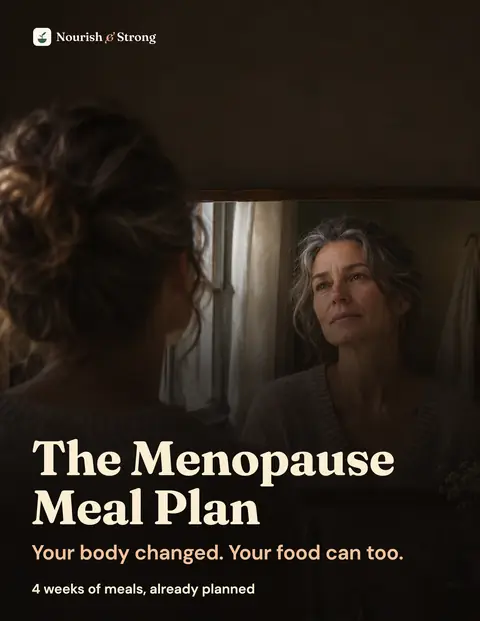
More protein, less guessing
The Menopause Meal Plan
4 weeks of high-protein meals with grocery lists and prep plans, so you can stop guessing what to eat. Only $12.
Quick questions
Can menopause cause insomnia?
Yes. Menopause is a recognized cause of insomnia, and sleep problems are reported by 40% to 60% of women in menopause. Waking in the night is the most common complaint. Hot flashes are the main driver, with mood changes and a higher risk of sleep apnea after menopause also playing a part.
How long does menopause insomnia last?
There’s no fixed timeline. Sleep often improves as hot flashes settle, and in the SWAN study hot flashes lasted a median of 7.4 years, longer for some women. The NHS says menopause symptoms usually last 7 to 9 years and change along the way. Treatment such as CBT-I can help long before then.
Is insomnia a sign of perimenopause?
It can be. The NHS lists trouble getting to sleep or staying asleep among perimenopause symptoms, often worse with night sweats. Sleep problems become more common in perimenopause even after allowing for age. Insomnia has many other causes, so look at it alongside other signs such as changing periods.
What does menopause insomnia feel like?
Most often it means waking in the night and struggling to get back to sleep, sometimes hot or sweaty. Some people find it hard to fall asleep or wake too early. The next day you may feel tired, irritable, anxious or foggy. Low mood is linked more with early waking and trouble falling asleep.
Does HRT help with menopause insomnia?
It can. A 2018 review found hormone therapy eases the sleep problems women report, especially when hot flashes are waking them. HRT has risks as well as benefits, and whether it suits you depends on your health history. CBT-I is the first-choice treatment for chronic insomnia and can be used with or without HRT.
What is CBT-I for menopause?
CBT-I is cognitive behavioral therapy for insomnia, a 6- to 8-week program done in person, by phone or online. It covers sleep habits, relaxation, a set time in bed and ways to calm worry about sleep. In a 2016 trial of women with menopausal insomnia and hot flashes, it cut insomnia scores twice as much as education alone.
This article is general information, not medical advice. If you have trouble sleeping for weeks, loud snoring or pauses in your breathing, or low mood, talk to your doctor. Don’t start, stop or change any medicine or sleep aid without your doctor’s advice.
Sources
- Baker FC, de Zambotti M, Colrain IM, Bei B. Sleep and Sleep Disorders in the Menopausal Transition. Sleep Med Clin, 2018
- McCurry SM et al. Telephone-Based Cognitive Behavioral Therapy for Insomnia in Perimenopausal and Postmenopausal Women With Vasomotor Symptoms: A MsFLASH Randomized Clinical Trial. JAMA Intern Med, 2016
- Qaseem A et al. Management of Chronic Insomnia Disorder in Adults: A Clinical Practice Guideline From the American College of Physicians. Ann Intern Med, 2016
- National Heart, Lung, and Blood Institute. Insomnia Treatment
- National Heart, Lung, and Blood Institute. Sleep Apnea Symptoms
- NHS. Insomnia
- NHS. Symptoms of menopause and perimenopause
- NHS. Things you can do to help menopause and perimenopause symptoms
- National Institute on Aging. Sleep and Older Adults
- Office on Women’s Health. Menopause symptoms and relief