

The short answer: a go bag is a ready-packed bag you can carry if you have to leave home fast. The Red Cross says it should hold at least 3 days of supplies: water (1 gallon per person, per day), easy food, a 7-day supply of medicines, copies of key documents, cash, a phone charger, a flashlight, a radio, a first aid kit and a change of clothes.
Ready.gov, FEMA’s preparedness site, says to build a go-bag so you don’t have to scramble when told to evacuate. You’ll also see it called an emergency go bag, a go-kit or a bug out bag.
What should be in a go bag?
A go bag should hold what keeps you safe for about 3 days away from home, plus papers and medicines that are hard to replace. This checklist combines the Red Cross and Ready.gov lists.
| Item | Why you need it | How much |
|---|---|---|
| Water | Drinking and basic washing | 1 gallon (about 4 liters) per person, per day; 3 days for evacuation |
| Food | Non-perishable, easy to prepare | 3 days per person |
| Medicines and medical items | Pharmacies may be closed or far away | 7-day supply, plus a written list of medicines and doses |
| Copies of documents | Prove who you are and where you live, and claim insurance | One set, in a waterproof bag |
| Cash | ATMs and cards may not work | A small amount, in small bills |
| Phone and chargers | Stay in touch and get alerts | Charger plus a backup battery |
| Flashlight | Light if the power is out | 1, plus extra batteries |
| Battery-powered or hand-crank radio | Hear official instructions | 1 |
| First aid kit | Treat small injuries | 1 |
| Clothes and shoes | Stay dry, warm and protected | A complete change per person, plus sturdy shoes |
| Emergency blanket | Warmth if you end up outside or in a cold shelter | 1 per person |
| Family contact list | Reach people if your phone dies | On paper |
| Map of the area | Find another route if roads close | 1 |
| Multi-purpose tool | Small fixes and opening cans | 1 |
| Hygiene and sanitation items | Soap, sanitizer, wipes, feminine supplies | A few days’ worth |
| Spare car and house keys | In case yours are lost or left behind | 1 set |
The Red Cross also suggests a whistle, masks, rain gear and work gloves, depending on local risks. Pack glasses, contact lenses and hearing aid batteries if anyone uses them. For what a good first aid kit holds, see our first aid kit checklist.
On medicines, Ready.gov suggests asking your doctor or pharmacist how to build an emergency supply, and keeping a cooler and chemical ice packs for any medicine that must stay cold. The Red Cross adds backup batteries and chargers for devices such as a CPAP machine.
What documents should be in a go bag?
A go bag should hold copies of the documents you’d need to prove who you are, get medical care and claim help after a disaster. FEMA’s checklist for safeguarding critical documents groups them like this:
- Identification: passports, driver’s licenses, birth, marriage and adoption certificates, Social Security cards and pet ownership papers.
- Home and money: lease, mortgage or deed, car registration and title, bank account details and insurance policies.
- Medical: a list of medicines, allergies, immunizations and medical devices, health insurance and Medicare or Medicaid cards, and contact details for doctors, pharmacies and vets.
- Contacts: family, employers, schools and anyone you’d need to call.
The Red Cross adds proof of address. Put paper copies in a waterproof pouch. FEMA also suggests password-protected electronic copies on a flash drive or a secure cloud service, with originals kept in a fireproof, waterproof box or with a trusted relative.
How much cash should you keep in a go bag?
No official agency names a dollar amount for a go bag. Ready.gov says to keep a small amount of cash in a safe place, in small bills, because ATMs and credit cards may not work during a disaster when you need to buy supplies, fuel or food. A practical way to choose: think about a few days of gas and food for your household.
Prefer to look first? See what’s in the free printable.
What should be in a go bag for kids and pets?
For kids, add baby supplies and something to do. The Red Cross lists bottles, formula, baby food and diapers, and games and activities for children. Ready.gov adds wipes and diaper rash cream, and books and puzzles. If someone relies on a power wheelchair or other battery-powered device, Ready.gov says to keep a spare battery charged.
For pets, Ready.gov’s advice is to keep two kits: a larger one for sheltering at home and a lightweight one to take if you evacuate. If officials tell you to evacuate, your pet should go too. Pack:
- Several days of food in an airtight, waterproof container, plus water and a bowl.
- An extra supply of any medicine your pet takes, in a waterproof container.
- A collar with ID tag, a harness or leash, and backups of each.
- A carrier or crate, ideally one per pet.
- Litter, a litter box and plastic bags if needed.
- Copies of your pet’s records, and a photo of you with your pet to prove ownership.
- A favorite toy or bedding to reduce stress.
Ready.gov says most public shelters allow only service animals, so find a pet-friendly place ahead of time. Leave the carrier out with treats inside so your pet gets used to it.
Where should you keep your go bag?
Keep your go bag in one agreed place at home where you can grab it on the way out, and make sure everyone knows where it is. Ready.gov also says to decide who is responsible for carrying it.
How to pack it so it works:
- Store items in airtight plastic bags, then pack everything in one or two easy-to-carry containers, such as a backpack or duffel bag. That’s Ready.gov’s advice.
- Keep it light enough that the person carrying it can walk with it. Ready.gov notes your evacuation route may be on foot.
- Keep a separate grab-and-go kit at work, with food, water, medicines and comfortable walking shoes. Ready.gov says to be ready to shelter at work for at least 24 hours.
Your car needs its own kit. Our car emergency kit guide covers the trunk.
How do you make an evacuation plan?
An evacuation plan answers three questions: how you’ll hear the order, where you’ll go and how you’ll find each other. These steps come from Ready.gov:
- Learn your risks and routes. Many states have evacuation zones and set routes. Check your state and county emergency management websites.
- Pick several places to go, such as a friend’s home in another town or a motel, in different directions.
- Choose a meeting place and a way to stay in touch if you’re separated, including an out-of-state contact.
- Sign up for local alerts and National Weather Service warnings.
- Keep at least half a tank of gas in the car at all times, since gas stations may be closed. If you don’t have a car, plan now how you’d leave.
- Practice the plan with your household.
When it’s time to go, Ready.gov says to leave early, take your kit and pets, follow the recommended routes without shortcuts, and never drive into flooded areas. If time allows, lock up, leave a note saying where you’re going, and check on neighbors who may need a ride.
What is the difference between a go bag and an emergency kit?
A go bag is what you carry when you leave. An emergency kit, or stay-at-home kit, is what keeps you going if you stay put. The Red Cross puts it simply: a go-kit holds at least 3 days of supplies you can carry, and a stay-at-home kit holds at least 2 weeks of supplies.
| Go bag | Stay-at-home kit | |
|---|---|---|
| Used when | You have to leave | You stay home through an outage or storm |
| Supplies for | At least 3 days | At least 2 weeks |
| Water | 1 gallon per person, per day, for 3 days | 1 gallon per person, per day, for 2 weeks |
| Medicines | 7-day supply | The Red Cross suggests 1 month in winter storm season |
| Container | A bag one person can carry | Bins or shelves at home |
Most households need both. Our home emergency kit list covers the stay-at-home side, including how to store water and what food keeps.
How often should you update a go bag?
Check your go bag at least once a year, and twice is easier to remember. Ready.gov says to replace expired items, rethink your kit every year and review pet kits regularly. Do it on the same day as your car kit. Swap out anything near its date, update documents and contacts, check the kids’ clothes still fit, and charge the backup battery.
Some emergencies call for the opposite of leaving. In a radiation emergency, official advice is to get inside and stay in, as our guide to what to do in a nuclear explosion explains. The plan below helps your family know which to do.
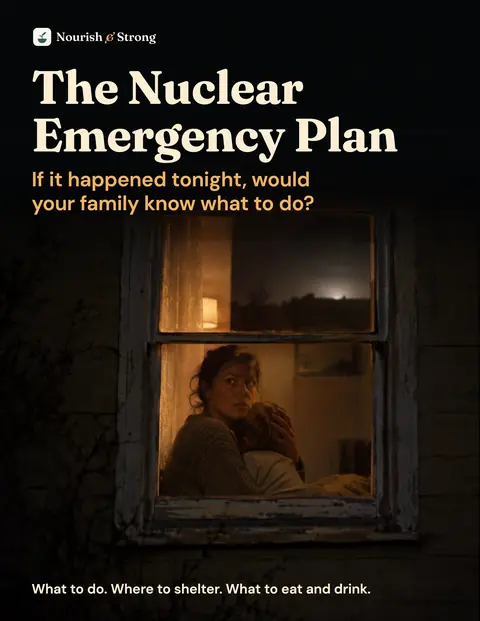
Your kit is one half of the job
The Nuclear Emergency Plan
A printable family guide built from official guidance: where to shelter, what to eat and drink, and a one-page card for your fridge. Only $7.
Quick questions
What is a go bag?
A go bag is a bag packed in advance with what you’d need if you had to leave home quickly in an emergency. The Red Cross says it should hold at least 3 days of supplies you can carry, including water, food, medicines, copies of documents, cash, a phone charger, a flashlight and a first aid kit.
How much water should be in a go bag?
Plan on 1 gallon (about 4 liters) of water per person, per day, for 3 days in a go bag, which is the Red Cross guidance for evacuation. That’s 3 gallons per person, which is heavy, so you may want to keep some in the bag and the rest in bottles by the door, ready to load.
What documents should I have in my go bag?
Keep copies of IDs and passports, birth and marriage certificates, proof of address, insurance policies, your home deed or lease, a list of medicines and allergies, and health insurance cards in your go bag. FEMA suggests keeping electronic copies too, password protected on a flash drive or in a secure cloud service.
Where should you keep your go bag?
Keep your go bag in one agreed place at home that’s easy to grab on the way out, and make sure everyone in the house knows where it is. Ready.gov also says to decide who will carry it. Keep a smaller kit at work and a separate kit in your car.
Is a go bag the same as an emergency kit?
No, a go bag is the smaller kit you carry when you evacuate, while an emergency kit for home is bigger. The Red Cross suggests at least 3 days of supplies in a go-kit and at least 2 weeks of supplies in a stay-at-home kit. Most households need both.
What should be in a go bag for a dog or cat?
A pet go bag should hold several days of food and water, a bowl, extra medicine, a collar with ID tag, a leash or harness, a carrier, litter if needed, copies of records and a photo of you with your pet. Ready.gov notes most public shelters allow only service animals, so plan a pet-friendly place.
This article is general information, not medical advice. Always follow evacuation orders and instructions from your local officials. Ask your doctor or pharmacist how to keep an emergency supply of your medicines, and don’t change how you take any medicine without their advice. In an emergency, call 911 or your local emergency number.
Sources
- Ready.gov (FEMA). Build a Kit
- Ready.gov (FEMA). Evacuation
- Ready.gov (FEMA). Make a Plan
- Ready.gov (FEMA). Prepare Your Pets for Disasters
- Ready.gov (FEMA). Financial Preparedness
- Ready.gov (FEMA). People with Disabilities
- FEMA. Safeguard Critical Documents and Valuables (FEMA P-1096)
- American Red Cross. Survival Kit Supplies
- American Red Cross. Winter Storm Safety