

The short answer: a good perimenopause meal plan gives you at least 25g of protein at each meal, plenty of fiber and two to three calcium-rich foods a day. The free 7-day menu below does that with 12 simple recipes, and you don’t need an email to use it. No food has been proven to stop hot flashes.
Pick a start day, shop once, and follow it.
What does a 7-day perimenopause meal plan look like?
Every meal comes from our free plan, A Week of Stronger Eating, with its protein after it. Add one glass of low-fat milk or calcium-fortified soy milk a day, which gives you about 8g more protein and some calcium.
| Day | Breakfast | Lunch | Dinner | Snack (approx.) | Protein |
|---|---|---|---|---|---|
| Mon | Greek yogurt bowl with berries and toasted seeds, 32g | Tuna, white bean and lemon salad, 34g | Sheet-pan salmon with greens and white beans, 42g | Apple and 1 oz almonds, 6g | 108g meals, about 122g with milk and snack |
| Tue | Overnight protein oats, 28g | Leftover sheet-pan salmon, 42g | Chicken fajita bowl, 43g | Orange and 1 oz walnuts, 6g | Meals 113g, about 127g |
| Wed | Cottage cheese and tomato toast, 29g | Leftover chicken fajita bowl, 43g | Cod with lemony white beans and green beans, 39g | ½ cup Greek yogurt and an orange, 14g | Meals 111g, about 133g |
| Thu | Spinach and feta scramble on toast, 34g | Leftover cod with white beans, 39g | Leftover chicken fajita bowl, 43g | Apple and 1 oz almonds, 6g | Meals 116g, about 130g |
| Fri | Overnight protein oats, 28g | Leftover chicken fajita bowl, 43g | Beef and broccoli stir-fry, 36g | Orange and 1 oz walnuts, 6g | Meals 107g, about 121g |
| Sat | Cottage cheese oat pancakes, 32g | Leftover beef and broccoli stir-fry, 36g | Shrimp and white bean tomato stew, 38g | ½ cup Greek yogurt and an orange, 14g | Meals 106g, about 128g |
| Sun | Leftover cottage cheese oat pancakes, 32g | Leftover shrimp and white bean stew, 38g | Egg and avocado open sandwich, 34g | Apple and 1 oz almonds, 6g | Meals 104g, about 118g |
All figures are approximate. Meal figures are our free plan’s estimates, and snacks are worked out from USDA FoodData Central.
The three meals plus milk come to about 1,450 to 1,700 calories a day, which is less than many women need. So the snack stays in, and you should add more if you’re hungry. The protein runs high on purpose, so smaller portions are fine.
Leftovers do the work: the sheet-pan salmon makes two portions, and Tuesday’s fajita chicken makes four. Chill cooked food within an hour. Eat fish, beef and shrimp leftovers within 2 days, and the chicken within 3.
Can diet help perimenopause?
Diet can’t stop the change, but it supports what’s happening under the surface. As your ovaries make less of their hormones, three quieter shifts shape this menu.
- Bone. In the large US SWAN study, rapid bone density loss began about a year before the final period.
- Muscle. Lean mass falls during this transition. Women who lost more had more fractures later, though that doesn’t prove cause. Protein helps most alongside strength training, which the NHS also advises for bones.
- Heart. LDL cholesterol rises steeply in perimenopause. Harvard says soluble fiber, found in foods like oats and beans, can help lower blood cholesterol. See foods that lower cholesterol.
See also perimenopause symptoms and what to eat during menopause.
How much protein, fiber and calcium do you need in perimenopause?
We didn’t find official numbers made just for perimenopause, so these are general adult targets. The higher protein range comes from experts writing about older adults, so treat it as a guide.
| Nutrient | Daily target | What this week gives you |
|---|---|---|
| Protein | 0.8g per kg of body weight is the standard guideline. An expert group suggests 1.0 to 1.2g per kg for older adults, or about 70 to 85g at 154 lb | 112 to 124g with milk, before the snack |
| Protein per meal | About 25 to 30g, based on muscle research | 28 to 43g |
| Fiber | 25 to 35g (Harvard), or 30g (NHS) | 27 to 34g from meals, plus about 5 to 7g from nut and fruit snacks |
| Calcium | 1,000 to 1,200 mg, depending on age | Not totaled in the plan. A cup of 1% milk has about 305 mg |
| Vitamin D | 600 to 800 IU, depending on age | Salmon, tuna, eggs and fortified milk help |
The British Dietetic Association keeps calcium simple: two to three servings a day. MedlinePlus says it can be hard to get enough vitamin D from food, so ask your doctor whether a supplement makes sense for you. More in how much protein do I need.
Can diet help hot flashes?
The honest answer is that the evidence is thin, and experts don’t fully agree. The Menopause Society’s 2023 statement did not recommend soy products, dietary changes or avoiding triggers as treatments for hot flashes. A Cochrane review of 43 trials found no conclusive evidence that phytoestrogen supplements work. Many trials were small.
The NHS and the British Dietetic Association still suggest cutting back on your own triggers, such as spicy food, caffeine, hot drinks and alcohol. Keep a note for two weeks and see if a pattern shows up. If you’d like to try soy foods, the British Dietetic Association suggests eating them daily for at least two to three months to find out.
If hot flashes wreck your sleep, talk to your doctor. Medical treatments have far better evidence than any food.
How do you build your own perimenopause meals?
Swap in your own meals with this three-step check:
- Start with 25g of protein. That’s about 1 cup of Greek yogurt, a 5 oz can of tuna, 3 oz of cooked chicken, or 7 oz of firm tofu. A can of chickpeas gives you 21g.
- Add a fiber food. Beans, oats, vegetables or fruit all count. Our list of high fiber foods has the grams. New to this much fiber? Drink extra water and give it a few days.
- Include a calcium food twice or more a day. Milk, yogurt, kale and calcium-fortified soy milk all work.
To check a meal of your own, try our free meal protein calculator. Breakfast is often the weak spot, so if you change one thing today, start with these high-protein breakfast ideas.
What should be on your shopping list?
The short version for one person, leftovers counted:
- Protein: 2 salmon fillets, 2 cod fillets, 1.1 lb chicken breast, 9 oz lean beef steak, 7 oz frozen shrimp, 1 can tuna, 1 dozen eggs
- Dairy: 32 oz plain Greek yogurt, 24 oz cottage cheese, feta, low-fat milk
- Cans and grains: 4 cans white beans, 1 can black beans, 1 can diced tomatoes, rolled oats, whole-grain bread, 6 microwave brown rice cups
- Produce and frozen: kale, spinach, broccoli, peppers, green beans, tomatoes, onions, lemons, frozen berries
- Snacks to add: 3 apples, 4 oranges, 3 oz almonds, 2 oz walnuts, and 1 cup extra Greek yogurt
What foods should you avoid in perimenopause?
These are most worth skipping or cutting back:
- Menopause powders and herbal remedies. The Menopause Society did not recommend supplements or herbal remedies for hot flashes, and the NHS says to talk to a doctor before taking them.
- Extra alcohol. The NHS says going over the recommended limit may affect your symptoms. See how much alcohol is safe.
- Cutting dairy with no replacement. If you drop it, choose calcium-fortified foods instead, so your bones don’t lose out.
When should you see a doctor?
Period changes are normal now, but see your doctor if you have:
- Very heavy bleeding, large clots, or a pad or tampon soaked every one to two hours
- Periods that last more than a week or come very close together
- Bleeding between periods or after sex
- Any bleeding after your periods have stopped for a year, even a small amount or just once. The NHS says it’s not usually serious, but it can be a sign of cancer
- Weight changes you can’t explain, such as losing 10 pounds or 5% of your weight over 6 to 12 months without trying
Check with your doctor before starting this plan if you have kidney disease, diabetes, high blood pressure, or a past or current eating disorder, or if you take regular medicines. Thyroid, bone, blood thinner and blood sugar medicines can be affected by food. If you’ve had breast cancer, ask your oncology team about soy. The menu contains fish, shellfish, dairy, eggs, wheat, soy and seeds, and the snacks add tree nuts.
Is there a free perimenopause meal plan PDF?
Yes. The free week on this page is enough to get started, and you can repeat it. For a printable, the free plan emails you a PDF version of a free week, with the recipes and grocery list. If you’d rather have a month done for you, The Menopause Meal Plan is a $12, 84-page printable PDF with four weekly menus, 45 recipes and grocery lists.
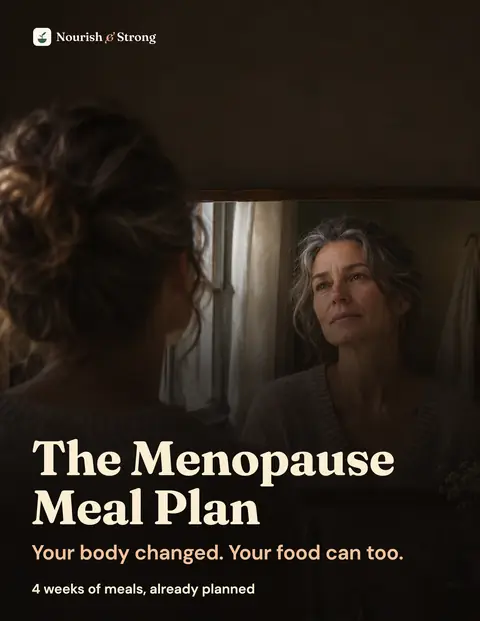
More protein, less guessing
The Menopause Meal Plan
4 weeks of high-protein meals with grocery lists and prep plans, so you can stop guessing what to eat. Only $12.
Quick questions
What is the best diet for perimenopause?
No single diet has been proven best for perimenopause. A sensible pattern is protein at every meal, plenty of beans, vegetables, fruit and whole grains, and two to three calcium-rich foods a day. Cleveland Clinic points to a Mediterranean-style diet as a good all-in-one option.
How much protein should I eat in perimenopause?
There’s no official perimenopause number. The standard guideline is 0.8g per kilogram of body weight a day, and an expert group suggests 1.0 to 1.2g for older adults. At 154 pounds, that higher range is about 70 to 85g. Aim for about 25 to 30g per meal. Ask your doctor first if you have kidney disease.
Can diet help perimenopause symptoms?
Diet may help some people feel better, but the evidence for symptoms is limited. The Menopause Society did not recommend dietary changes as a treatment for hot flashes in 2023. Food still matters for your bones, muscles and heart. If symptoms disrupt your life, ask your doctor about treatment.
What foods should I avoid during perimenopause?
No food needs to be banned. The NHS suggests cutting back on possible hot flash triggers, such as spicy food, caffeine and hot drinks, and staying within recommended alcohol limits. These triggers vary from person to person, so a two-week note can show whether any of them affect you.
Does eating soy reduce hot flashes?
Soy may help some people, but the evidence is mixed. The Menopause Society did not recommend soy products for hot flashes in 2023, and NCCIH reports inconsistent results from studies of soy isoflavones. The British Dietetic Association suggests trying soy foods daily for two to three months to see if they help you.
Is there a free perimenopause meal plan PDF?
Yes. Our free plan, A Week of Stronger Eating, is a printable PDF with 21 meals, recipes and a grocery list, and it’s sent by email. The same week of meals is on this page with no email needed, so you can start using it today without signing up.
This article is general information, not medical advice. Nutrition figures are approximate and vary by brand and portion. If you have kidney disease, diabetes, high blood pressure, a history of an eating disorder or breast cancer, a food allergy, or take regular medicines, talk with your doctor before following this plan. See a doctor about any unusual bleeding.
Sources
- A Week of Stronger Eating: meals, protein, fiber and calorie estimates, Nourish & Strong
- Perimenopause, Cleveland Clinic
- What Is Menopause? National Institute on Aging
- Karlamangla AS et al. Anti-Mullerian Hormone as Predictor of Future and Ongoing Bone Loss During the Menopause Transition. J Bone Miner Res, 2022
- Shieh A et al. Menopause-Related Changes in Body Composition Are Associated With Subsequent Bone Mineral Density and Fractures: SWAN. J Bone Miner Res, 2023
- El Khoudary SR et al. Low-density lipoprotein subclasses over the menopausal transition: the SWAN Heart and HDL ancillary studies. Menopause, 2023
- Bauer J et al. Evidence-based recommendations for optimal dietary protein intake in older people: PROT-AGE. J Am Med Dir Assoc, 2013
- Paddon-Jones D, Rasmussen BB. Dietary protein recommendations and the prevention of sarcopenia. Curr Opin Clin Nutr Metab Care, 2009
- How much protein do you need every day? Harvard Health Publishing
- Fiber, The Nutrition Source, Harvard T.H. Chan School of Public Health
- How to get more fibre into your diet, NHS
- Calcium in diet, MedlinePlus
- Vitamin D, MedlinePlus
- What to eat during menopause, Cleveland Clinic
- Menopause and diet food fact sheet, British Dietetic Association
- 2023 Nonhormone Therapy Position Statement press release, The Menopause Society (then NAMS)
- Lethaby A et al. Phytoestrogens for menopausal vasomotor symptoms. Cochrane Database Syst Rev, 2013
- Menopause Symptoms and Complementary Health Practices, NCCIH
- Things you can do to help menopause and perimenopause symptoms, NHS
- Postmenopausal bleeding, NHS
- Weight loss, unintentional, MedlinePlus
- Weight gain, unintentional, MedlinePlus
- Nuts, almonds, USDA FoodData Central
- Nuts, walnuts, english, USDA FoodData Central
- Apples, gala, with skin, raw, USDA FoodData Central
- Oranges, raw, navels, USDA FoodData Central
- Yogurt, Greek, plain, lowfat, USDA FoodData Central
- Milk, lowfat, 1% milkfat, USDA FoodData Central