

The short answer: the NHS says it’s not always obvious what causes back pain. But a few common habits can keep it going: too much rest, long spells of sitting, your sleep position and fixes that guidance doesn’t support. If it hasn’t improved after a few weeks, see your doctor. Get emergency help for symptoms in both legs, numbness around your genitals or bottom, or bladder or bowel changes.
You get up from a chair and your hand goes straight to your back. Again. It isn’t terrible, but it’s always there, and you’ve started planning your day around it.
Go through this list and see which ones sound like you. Most are things you can change this week.
1. You’re resting it too much

When your back hurts, the sofa feels like the sensible choice.
The NHS says the opposite: stay active, carry on with your daily activities as best you can, and don’t stay in bed for long periods.
What to do: stand up and walk for a couple of minutes now. Then read what actually works for back pain.
2. You’re sitting still for too long

The American Academy of Orthopaedic Surgeons says low back pain often gets worse with long periods of sitting. Arthritis UK says staying in the same or an awkward position may increase your pain or your recovery time.
So the problem may be the stillness as much as the chair.
What to do: get up at least once an hour, as Arthritis UK suggests, and more often on sore days. Here’s how to set up your chair and desk.
3. Your sleep position is working against you

If your back is worst in the morning, look at the night. Cleveland Clinic says sleeping on your stomach tends to throw your neck and spine out of line, and that a soft, sagging or damaged mattress can do the same.
What to do: try your side with a pillow between your knees, or your back with a pillow under them. Both are advised by Mayo Clinic and Cleveland Clinic. See where to put your pillows, and how to tell if it’s more than ordinary morning stiffness.
4. You haven’t found movement you’ll keep doing

A 2021 Cochrane review found exercise is probably effective for long-term low back pain. But no single move stands out as the answer. Arthritis UK suggests choosing something you enjoy, so you’ll stick with it.
The NHS says walking, swimming, yoga and Pilates may all help ease back pain.
What to do: pick one and give it a regular slot. If you’d rather start at home, try these five gentle exercises. Stop if your pain gets worse.
If number 4 sounds like you
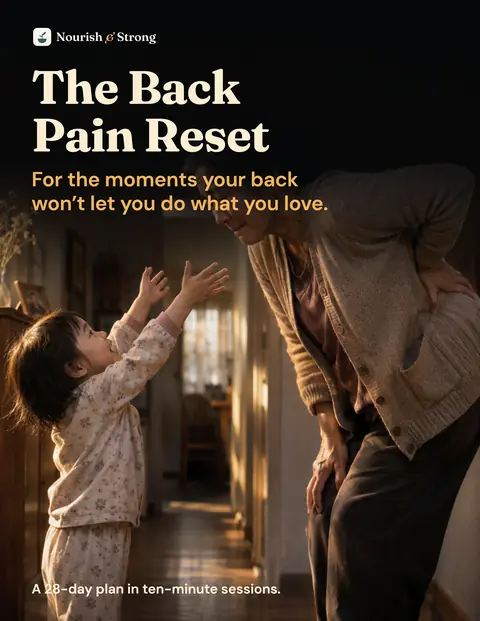
The Back Pain Reset
A 28-day plan that tells you what to do each day, in ten-minute sessions, with 12 illustrated exercises. Only $3.
5. You’re relying on the wrong fixes
It’s easy to spend money on back pain. Some of the most popular fixes aren’t backed by UK guidance:
- Belts or corsets: NICE says not to offer them.
- Foot orthotics: NICE says not to offer them.
- Paracetamol on its own: not recommended by the NHS or NICE, though it may be used with another painkiller.
- A routine scan: NICE says not to routinely offer imaging in a non-specialist setting.
What to do: the NHS suggests anti-inflammatories like ibuprofen, which may not suit everyone, and a wrapped ice or heat pack. Check with a pharmacist if you’re unsure. For a bad day, keep our free Back Pain Rescue Card to hand.
6. It may not be a simple sore back

Sometimes the pain has a different pattern, and so does the fix.
- Sharp or burning pain down the back of one leg can be sciatica, the NHS says. Start with what helps sciatica and how long it usually lasts.
- Pain in your buttock or hip can travel from your lower back. This guide explains what hip pain means, by where it hurts.
- Stiffness that lasts more than 30 minutes each morning, or keeps going for more than a week, is worth raising with your doctor.
7. It’s time to get it looked at
The NHS says back pain often improves within a few weeks. Arthritis UK says it should start to ease after 2 weeks and usually passes after 4 to 6 weeks. If yours hasn’t, you aren’t doing anything wrong. You may need more than self-care.
The NHS says other options may be recommended if it doesn’t improve, including group exercise, physiotherapy and manual therapy.
See your doctor if:
- It hasn’t improved after a few weeks at home
- It’s stopping your day-to-day activities
- You’ve lost weight without trying
- It’s worse at night, or doesn’t improve after resting
Call emergency services or go to the emergency department if you have back pain and:
- Pain, tingling, weakness or numbness in both legs
- Loss of feeling around your genitals or bottom
- Changes in your bladder or bowels, such as difficulty peeing or losing control
- Chest pain
- Pain that started after a serious accident
What should you do next?
Pick the one reason that sounded most like you and change that first. One small change you keep will do more than seven you drop by Friday.
Want it laid out day by day?
The Back Pain Reset
A 28-day plan in ten-minute sessions, built from NHS, WHO and Arthritis UK guidance, with three levels and a rescue card for bad days. Only $3, with a 14-day refund.
Quick questions
Why does my lower back keep hurting?
Common reasons include resting too much, sitting for long spells, your sleep position, or relying on fixes that guidance doesn’t support. Sometimes the pain comes from something else, such as sciatica. The NHS says to see your doctor if it hasn’t improved after a few weeks.
How long should lower back pain last?
The NHS says back pain often improves within a few weeks. Arthritis UK says it should start to ease after 2 weeks and usually passes after 4 to 6 weeks.
Is it better to rest or keep moving with back pain?
Keep moving as best you can. The NHS says to stay active and not to stay in bed for long periods.
When is lower back pain an emergency?
Get emergency help if you have pain, tingling, weakness or numbness in both legs, loss of feeling around your genitals or bottom, or changes in your bladder or bowels.
This article is general information, not medical advice. If you’re worried about your pain, please talk to your doctor.
Sources
- NHS. Back pain. Reviewed March 2026.
- NHS. Sciatica. Reviewed December 2024.
- NICE. Low back pain and sciatica in over 16s: assessment and management (NG59).
- Hayden JA, et al. Exercise therapy for chronic low back pain. Cochrane Database of Systematic Reviews, 2021.
- Arthritis UK. Back pain: information and exercise sheet.
- Arthritis UK. Back pain: symptoms, causes and treatment.
- American Academy of Orthopaedic Surgeons. Low Back Pain.
- Cleveland Clinic. Why Your Lower Back Pain Is Worse in the Morning.
- Cleveland Clinic. Best Sleeping Positions for Pain.
- Mayo Clinic Staff, via Memorial Health System. Sleeping positions that reduce back pain.